

Why are Kingston streets named
for hockey players?
In Toronto, there isn’t a Dave Keon Road or Johnny Bower Way either.
While Canadians love their hockey stars, you just don’t often see thoroughfares named after them.
Except in Kingston. And there’s not just one street – but a handful.
Conacher Drive is named after the Chicago Black Hawks and Montreal Maroons star Lionel Conacher. And Morenz Crescent pays tribute to the great Howie Morenz. But neither was from Kingston.
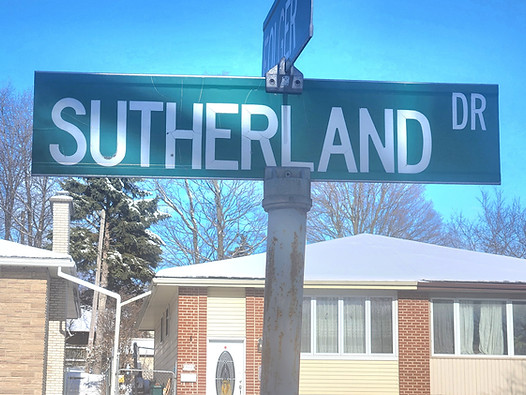
A third, Sutherland Drive, actually honours a Kingstonian, Capt. James Sutherland, the founder of the Memorial Cup and the driving force to establish the Hockey Hall of Fame in 1943.
Then there’s Cherry Street and Gilmour Avenue. However, you’d be wrong if you said that the first was named after the star of Coach’s Corner and the second for the legendary Leafs player. Both streets were already around before they came along.
Some wags have suggested submitting a request to the City of Kingston to change Gilmour Avenue to Killer Avenue, to reflect Doug’s Gilmour’s nickname. It doesn’t seem like that will be happening.
So how did we get here?
“The naming of three Kingston streets for hockey players is thanks to Gus Marker, who moved to Kingston after hanging up his skates,” says Mark Potter, past president of the Original Hockey Hall of Fame.
Marker, who was from Alberta, not Kingston, played in the NHL for a decade starting in 1932, skating with the Montreal Maroons, Detroit Red Wings, the Leafs and the Brooklyn Americans.
He won the Stanley Cup in 1935 with the Maroons. In those days, the compensation was meagre. “All we got for winning the Cup was a watch fob and a train ticket home,” Marker lamented for many years following the victory.
The following year, on March 24, 1936, he took part in the longest game in NHL history. It was a Stanley Cup playoff match that saw the Red Wings defeat the Maroons in the sixth overtime period.
He went on to play for Toronto under the wing of the legendary Conn Smythe. Following Marker’s retirement in 1942, Smythe helped him get started in the construction business in Kingston. Marker established Marker’s Building Materials.
“Originally, Marker had his sights set on opening a bowling alley when he came to Kingston,” Potter says. “But Smythe convinced him that the concrete business was more lucrative – and it made Marker a multimillionaire, which was huge in that era.”
In addition to running the concrete company, Marker built a subdivision in the city’s north end, known as Marker’s Acres. Grabbing the bull by the horns, Marker decided to name some of the subdivision’s streets himself, honoring the hockey greats of his era. They were:
Lionel Conacher
Conacher was a teammate of Marker on the 1935 Stanley Cup-winning Maroons. He had already won the trophy the previous year with the Chicago Black Hawks.
However, he was more than a hockey player. He helped the Toronto Argonauts capture the Grey Cup in 1921, making him one of only three people to have their names engraved on both the football and hockey trophies. His multisport prowess was so strong that he was voted the top athlete in Canada in the first half of the 20th century.
Howie Morenz
Born in Mitchell, Ontario, Morenz was known as the Mitchell Meteor for his speed on the ice. He helped the Montreal Canadiens to win three Stanley Cups. Tragically, he died in 1937 at the age of 34 after complications from a broken leg he suffered in a game.
On the 100th anniversary of the founding of the NHL in 2017, Morenz was named as one of the top 100 players in league history.
While Gus Marker did not play on the same team as Morenz, he trained with him during the summers. He wanted to honour him following his untimely death.
James T. Sutherland
Sutherland made two huge contributions to hockey in this country. He founded the Memorial Cup, the trophy of junior hockey supremacy. And he was the driving force behind the creation of the Hockey Hall of Fame.
A volunteer hockey coach, Sutherland served as a major in the Canadian army in Europe in the First World War. Two Kingston hockey players who served under him – George Richardson and Scotty Davidson – were killed in action. Sutherland was devastated by the loss and after the war he decided to establish the trophy to remember them and all who were killed.
After visiting the baseball hall of fame in Cooperstown, New York, Sutherland became convinced that hockey needed a similar shrine. He believed (wrongly, as it turned out) that Kingston was the birthplace of hockey and therefore the hall should be located here. In 1943, he persuaded the Canadian Amateur Hockey Association and the NHL to designate Kingston as the site for the hall.
“Gus Marker knew, and had great respect for, Capt. Sutherland and the importance of the work he was doing to celebrate hockey,” says Potter.
While Marker didn’t get a Kingston street named after him, his legacy lives on. Since 1980, the Kingston Kiwanis Club has honoured an outstanding local amateur athlete with the Gus Marker Trophy. Two Olympic gold medalists are among those who have hoisted the prize: Jayna Hefford in hockey, who was feted in 1997; and triathlete Simon Whitfield, who was honoured in 2000.
Gus Marker died in 1997 at the age of 92.